Posts

Showing posts with the label DIY

Assistive Technology Devices you Can Create to Use in Your Classroom

Image
By: Maria Mazzola, EC-SEAT Scholar What is Assistive Technology? Devices and services that help individuals with special needs. They help people with disabilities: remember, read, see, communicate, and listen. iPad/iPhone Stands iPad/iPhone stands are a great assistive technology to use in the classroom and at home. These stands help children or individuals keep their device in place without having to hold it up. This assistive technology can be helpful especially to children or individuals with physical disabilities such as Cerebral Palsy or Muscle Dystrophy. Materials: coro-claw, exacto knife, sharpie corrugated plastic, double sided foam tape scissors, ruler. Sandwich holder A sandwich holder is a great assistive technology device to use with children and individuals with disabilities. This device allows an individual to eat a sandwich without having to use their hands. This device can be mounted onto a wheelchair as well. Materials: corrugated plastic, Coro-claw, loc-line, double-...

Creating Simple Low-Tech AT Devices at Home

Image
By: Holly Bogardus , EC-SEAT Scholar Once we realize the possibilities of the materials around us, it becomes easier to envision ourselves creating useful tools for those we work with. Assistive devices do not need to be bought, or cost hundreds of dollars. Below you will find a few simple and cheap devices that address an assortment of needs. While looking at these devices I encourage you to consider a problem you or another has or is experiencing, and if there could be a simple solution at hand. Looking at materials in new ways can open many possibilities of utilizing things creatively to increase a person's ability to perform a task, or to be better focused and engaged in an activity. Simple solutions are out there if we can think creatively as well as critically. Visual Complexity Reduction Device Materials: Magnets (2) Tools: None This is a tool for visual complexity reduction using 2 magnets. I chose a colorful frame to help focus the attention, and the black strip ...

Do it Yourself Easy Tablet Adaptations

Image
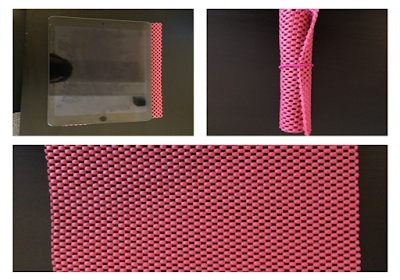
By: Ryan Keefe, EC-SEAT Scholar I based these adaptations primarily off of what could easily help a family in need. As a paraprofessional, I have worked with many families who have little available to them. These adaptations, are easy "do it yourself" (DIY) remedies to issues that may be found when using an iPad or other tablet at home, school, or in the community. This is your basic under the carpet runner that you use under a carpet on a hardwood floor. You can find it at many local hardware or drug stores. Low and behold it can also work as a great no-slip mat for a tablet that does not have a case. This can often be an item lying around the house after laying down a new carpet, but it can also help with using as a placemat for an tablet. When the tablet is set on the mat a child is able to swipe and use the tablet without it slipping around on the surface it is placed on, which can also keep it from falling to the floor and suffering a fatal blow. Often a ch...

Low-Tech Ways for Adapting Books for Fine Motor

Image
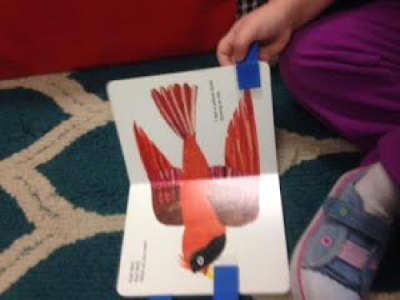
By: Teresa Loos , EC-SEAT Scholar Part of teaching children with special needs includes providing them with a least restrictive environment in which they have access to the curriculum, opportunities to participate, and can be supported and accommodated in their education. As an educator, I live by  Universal Design for Learning  and the  National Association of Education for Young Children and the Division for Early Childhood’s Position Statement on Inclusion , which ensures that children with special needs have access, participation, and support. When people think of assistive technology, the assumption is some sort of device they can use. However, according the Assistive Technology: principles and practices, assistive technology is a broad range of devices, services, strategies, or practices that can be implemented to eliminate or alleviate problems of an individual with special needs (Cook & Hussey, 2002). Assistive technology can also be low-tech and does n...

Using Corrugated Plastic for Assistive Technology

Image
By: Katie McCormack , EC-SEAT Scholar Assistive technology is defined as “any item, piece of equipment, or product system, whether acquired commercially off the shelf, modified, or customized, that is used to increase, maintain, or improve functional capabilities of a child with a disability” (Individuals with Disabilities Education Act, 2004). To the average person, the term “assistive technology” may be associated with expensiveness, technicality and complication. Unquestionably, assistive technology is a great concept, providing opportunities and opening previously closed doors to individuals with disabilities. Yet when thinking about the process of creating assistive technology, it can seem a bit intimidating… don’t you need a computer science or engineering degree? Don’t you have to use expensive tools and materials? Don’t you need to work in a special factory or lab? Well, yes. Sometimes. However, it is a little known fact that anyone (yes even YOU) is capable of creati...