Posts

Showing posts with the label EC-SEAT

Hands-on Use of Assistive Technology Learning in the Classroom

Image
By: Kimberly Chouinard, ECSEAT Scholar Over the past few years I have taken a few courses in Assistive Technology though my program here at the University of New Hampshire. I have learned to “use what you have” for support or to make things accessible for learners. This semester I had a great experience with a student in my class that I would like to share. A student in my class who experiences motor delays started to grow.  That’s great!  We love growth!  But, this growth caused seating issues and it takes time to fit, order and receive new equipment. He seemed to be growing out of his supportive chair and tray. His legs had grown and his feet where not well positioned on the foot support any longer. This growth caused his feet to slide off the foot support, kick out and limit accessibility to table activities with peers. I took my concerns to our team. His nurse, Physical Therapist and I were able to identify the problem (i.e., the foot plate was now too short for his g...

Reflection: How Cultural Influences Have Impacted Early Childhood Education

By:  Caitlyn Pagnottaro, ECSEAT Scholar So much has changed since I was a young child starting school. Looking back I can see what we valued then compared to what we value today. I remember that I played a lot. If we had circle time and other structured parts of the day I don’t remember it. I remember playing. I remember playing with my friends at the time inside and outside of the classroom. The preschool/kindergarten that I attended was private and the play area that we had behind our building was amazing. At least from what I recall as a small child it was because everything around me seemed so much bigger. There was a huge climbing structure that I used to hang off of, or climb to the highest point as if I were on the top of the world. We had this playhouse that you could climb up to which my girlfriends and I would all go up to together and hangout and giggle. I can’t remember anything academic that we ever did in preschool unless it involved a book and that was a...

App Review: SeeSaw Learning

Image
By:   Kimberly Chouinard , EC-SEAT Scholar App Review : SeeSaw Learning During this time of remote learning, as of April 2020, it is important to consider a few features in selecting the right app for your program's needs and students in presenting, monitoring and assessing student performance: 1. How easy is this SeeSaw Learning app to use for teachers? This app is easy to navigate. It offers tutorials and support pages for teacher to support its use. 2. Ease of use for families and security of information? Parents are invited by teacher to join SeeSaw via email using their email and student code.  For remote learning, parents need to join as the "student" in order to complete work and share with teacher on the app. Compatible with several devices including, Chromebooks, computers, iPads, iPhones, Android tablets, Android phones, and Kindle Fire. 3. What ways or modes will this app give teachers to share learning experiences? The app contains a library of activiti...

Reflection From the Field: A Teacher’s Experience with Planning Remote Learning

Image
By: Kimberly Chouinard,  EC-SEAT Scholar This week started with a bang! It’s hard to believe it still the same week, actually, it is a blend of 2 weeks. On Friday 3/13 the state of NH announced that all schools would be closed and move forward with a remote learning model during the COVID-19 pandemic. On Friday (3/13), my school district sent an email asking staff to work from home on Monday (3/16) and to review options and ideas for beginning a remote learning model for their grade level.  On Monday (3/16) we had the first of many, preschool team Zoom meetings. We collaborated, shared, planned, and came up with a plan to begin to move forward planning for remote learning. 1.     We agreed to create an activity calendar, with four developmental subheadings to work on for both the 3- and 4-year old programs. 2.     We planned how we wanted to explain to parents how to implement these suggested activities at home. 3.     We divided th...

Early Intervention and Resources to Learn more about Children's Development

By: Carrie Portrie , M.Ed, EC-SEAT Project Coordinator and PhD Student in Education While perusing my Facebook feed this afternoon, I saw a post from Zero to Three: National Center for Infants, Toddlers and Families  on  2015 Baby Facts by State and Toolkit . As I jumped to the site, I began thinking about all the wonderful resources for families caring for and professionals working with infants and toddlers. Learning about and observing children's development early on is joyous and is also important for detection of potential concerns. When a potential concern, developmental delay or disability is detected families can access early intervention for their child. What is early intervention? The  Center for Parent Information and Resources (2014) overview  explains it is "Authorized by law. Early intervention is available in every state and territory of the United States. The  Individuals with Disabilities Education Act  (IDEA) requires it–Part C o...

Handmade Tools Part 1 Stylus and Fingerless Glove - Adapting the iPad for Children with Disabilities

Image
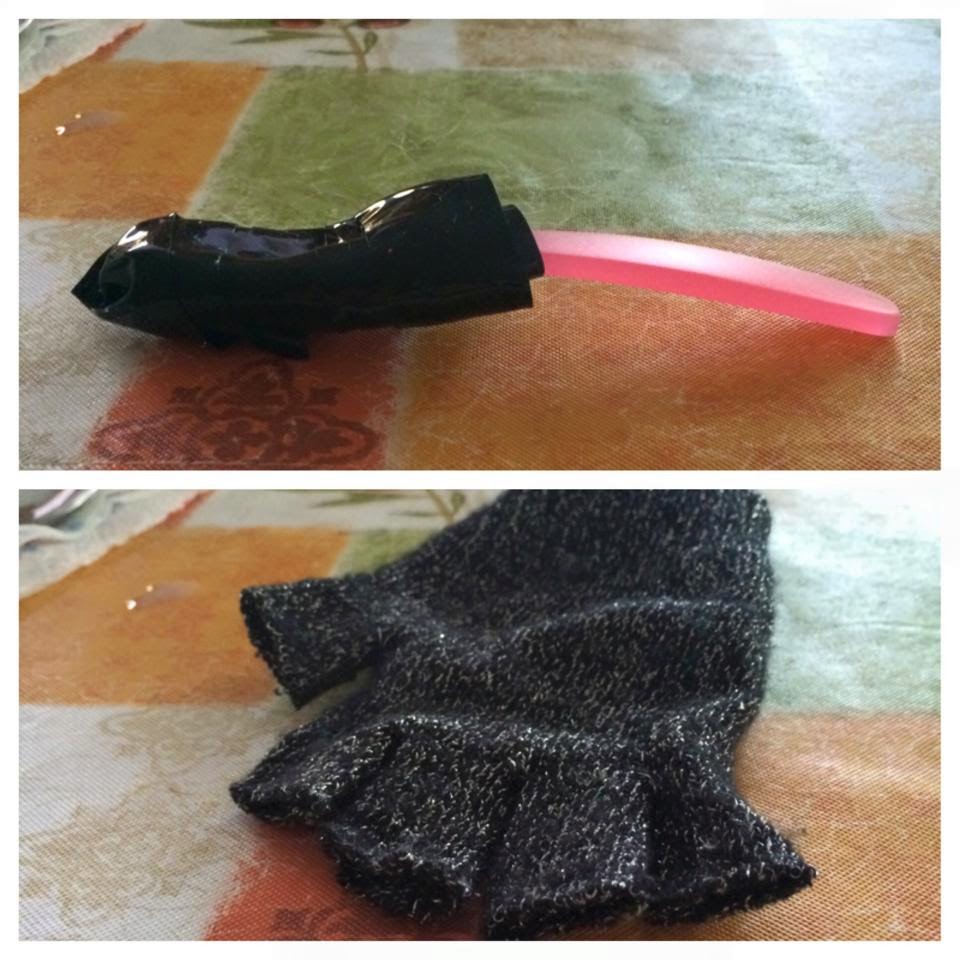
Lauren Pasquazzi , EC-SEAT Scholar and Assistant Preschool Teacher The first adaptation I created is a pen for the iPad. This pen is specifically designed for young children because one of the materials that was used was a child's utensil. This helps a child to have a better grip when using it. I also used conductive foam and ez fuse tape.  The second adaptation I created is a glove with the finger cut off. This can help children who may have a difficult time using a touch screen and end up putting all of their hand on the screen. The screen won't detect the glove only the skin which is where the fingers will be. Meg Foehl , EC-SEAT Scholar and Preschool Teacher The first adaptation is used to help a child isolate the use of his or her pointer finger. It is made from a child's cotton winter glove with the tip of the pointer finger cut off. The second adaptation is a low cost simple to make diy stylus. It is made out of an old pen, a q-tip, ...

Mentorship

By:  Pam Miller Sallet , MSEd, EEIN Mentorship Program Coordinator Mentorship is a type of professional development used in many fields to enhance a new or less experienced student or employee’s (mentee’s) skill and knowledge through “coaching” from a more experienced person (mentor) in the field.   The power of the mentorship experience is the relationship that is created through spending time talking and learning about topics of interest over time.   It is the individualized and flexible nature of mentorship that allows the mentee to take charge of their learning and make meaningful growth.   Self-directed learning is powerful in its impact on an individual’s career. I have been coordinating an early childhood mentorship program for many years, and a consistent message from mentors is that the learning has been a “2-way street”, with both parties helping the other to grow in their awareness and understanding.   A surprising outcome after the formal me...

Responsive Language with Children

Image
By: Hannah Arnold, EC-SEAT Scholar and Preschool Teacher How we respond to children has a lot to do with how they respond to us. Treating children with respect and dignity goes a long way towards increasing positive behaviors in your classroom. We can treat children with respect and dignity through our everyday interactions and responsive language. Responsive language shows children that we believe in them by using direct language, which reinforces positive behavior. Responsive language is a part of having a responsive classroom that fosters social and academic learning throughout the day. Using responsive language with children of all ages may seem like a gigantic step and can seem a bit overwhelming if you are new to the idea. However there are small steps you can take towards becoming more responsive. At first this type of language is very conscious and planned out. As you become more comfortable it almost becomes second nature. When first starting the use of responsive I fou...

Follow our blog and look for upcoming posts from EC-SEAT scholars!

The beginning of the 2014-2015 academic year for the EC-SEAT scholars and the project is off to an energetic start. Throughout the year, scholars will be writing blogs! Check back to our site often to see what scholars are saying about their practice in the field. Also, please comment! · Tell us what you want to know more about. · Offer to write a blog. · Provide resources and links for us to post to our site. We want this to be a community of practice.

Tip Sheets for Assistive Technology (AT), Embedded Instruction and Universal Design for Learning (UDL)

We have recently developed four tip sheets for professionals and families working with young children experiencing disability and their peers in early childhood and early intervention. Follow the links below for a PDF version. Assistive Technology Assistive Technology & Young Children Embedded Instruction Universal Design for Learning

Multi-level Collaboration: Being aware, having conversations and moving toward change together

Navigating the research and policies regarding learning outcomes, competencies, goals, standards from federal and state organizations can be quite overwhelming. The documentation exceeds the field of early childhood and special education to include public health, medicine and more. With good reason, many educators are wary of standards for their “one size fits all” notions, but standards are dynamic not static. They can empower children and educators and offer professional preparation “more valuable than a list of rules to follow,” (NAEYC, 2009, p. 2). The question remains, how do we work together effectively to implement standards and coordinate professional practices? The United States Office of Planning Research and Evaluation, Administration for Children and Families (OPRE) released Conceptualizing and Measuring Collaboration in the Context of Early Childhood Care and Education offering some suggestions. Professionals working one-on-one, in classrooms, and in state-level agencies...