Posts

Showing posts with the label Collaboration

Assistive Technology Maker Spaces and Collaborations - Working together across sectors!
Image
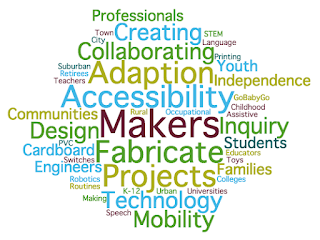
By: Carrie Portrie, M.Ed, EC-SEAT Project Coordinator Assistive Technology  - Design, Collaboration, and Making On Saturday, September 29th, I attended the Assistive Technology Makers Fair  at the Grappone Center in Concord, NH with five EC-SEAT project scholars. The event was coordinated by Dr. Therese Willkomm and Stacy Driscoll of  ATinNH.org at the University of New Hampshire's Institute on Disability in collaboration with a planning committee of national stakeholders . I attended sessions that emphasized design and the importance of collaborative inquiry and work across areas of expertise. It made me think about project learning and how students of all ages and professionals can help design, find, and make assistive technology solutions for people of all ages who have disabilities.  Families, professionals, and communities can help people with disability have greater accessibility in their daily lives by embracing the ideas behind design and maki...
Selecting Assistive Technology (AT) for young children - a cooperative decision of understanding

Image
By: Carrie Portrie , M.Ed, EC-SEAT project coordinator Selecting AT for young children birth to age 8 takes time, creativity and collaboration. While searching through current AT related articles and websites this morning, I found myself at Understood.org reading articles by Amanda Morin . She reminds parents of their role and provides resources to support AT device and service selection for children. Creating an opportunity for parents and educators to talk together about AT, is essential to successful implementation and consistency. Morin (2014) provides a checklist of questions for parents to ask when AT is being considered for their child. A few questions she lists are: "How will AT help my child learn more successfully? Will it help him become a more independent learner? Which of my child’s issues will this tool address? How will it help him work around his challenges? What strengths does he have that will work well with certain tools or devices? (For example, a ...

Technology in the Early Childhood Classroom - A wealth of resources to use and share

Blogpost by: Carrie Portrie, M.Ed, EC-SEAT Project Coordinator The more I talk with other early childhood educators and the more I learn about using technology with some of our youngest children, I find myself coming back to the Colorado Department of Education Results Matter video library.   What strikes me about each video is the wealth of resources and practical suggestions. Wondering about documentation using Teaching Strategies (TS) Gold ? Want to know about recommended websites and apps that teachers are using with young children? This could be a great place to start. Also below are some other useful sites mentioned in the Results Matter video  Using Technology to Enhance Instruction and Family Engagement   (and some additional resources).  What are your favorites that you would recommend to others? How do you get inspired?  New England Aquarium - Live Stream NGAKids Art Zone - National Gallery of Art (you will need the Shockwave plug-in and do...

Communicating with Families: Utilizing Interactive Technology at Home and in School

Image
Written by: Maggierose Smith , EC-SEAT scholar and interning graduate student           Working in the classroom environment, I often do not see the families of the children as a majority of the students ride the bus in and out of school. To update the families on what their child was working on and experiencing in school, I wrote general newsletters to families.  When beginning to work one-on-one with a student, I wanted the skills to be practiced at home as well as in school. The child often spoke of his iPad at home including the apps he enjoyed using. I incorporated the iPad into his work at school, and found the child was extremely engaged during our time together and enjoyed many of the apps. Knowing the child had an iPad at home, I sent home a letter to parents featuring the Free apps we had been using in hopes they would add these to their iPad for the child to use in the home.  After receiving the l...

Obama Signs Bill to Revamp Child Care Aid*

Image
This is truly an exciting time for the field of Early Childhood. Check out some of these other links for more information about early childhood policy and initiatives** Annie E. Casey Foundation Association of University Centers on Disabilities Carsey School of Public Policy at the University of New Hampshire Center on the Developing Child   at Harvard University Child Care Aware Children's Defense Fund Division for Early Childhood (DEC) First Five Years National Association for the Education of Young Children  (NAEYC) National Conference of State Legislatures U.S. Office of the Administration for Children and Families Zero to Three National Center for Infants, Toddlers and Families *The link from the Washington Post attached to this title is no longer active **This list is not comprehensive nor representative of EC-SEAT particular viewpoints. It is simply a resource for gathering knowledge and initiating discussion.

Mentorship

By:  Pam Miller Sallet , MSEd, EEIN Mentorship Program Coordinator Mentorship is a type of professional development used in many fields to enhance a new or less experienced student or employee’s (mentee’s) skill and knowledge through “coaching” from a more experienced person (mentor) in the field.   The power of the mentorship experience is the relationship that is created through spending time talking and learning about topics of interest over time.   It is the individualized and flexible nature of mentorship that allows the mentee to take charge of their learning and make meaningful growth.   Self-directed learning is powerful in its impact on an individual’s career. I have been coordinating an early childhood mentorship program for many years, and a consistent message from mentors is that the learning has been a “2-way street”, with both parties helping the other to grow in their awareness and understanding.   A surprising outcome after the formal me...

Watch Me! Celebrating Milestones and Sharing Concerns | Watch Me! | Learn the Signs. Act Early. | NCBDDD | CDC

Follow this link to the Center for Disease Control (CDC)'s Watch Me! 4-Module series. This is an excellent resource for childcare providers. Share with others. The Modules take a little over an hour to complete, and you can receive a certificate of completion at the end if you take the final evaluation after Module 4. Watch Me! Celebrating Milestones and Sharing Concerns | Watch Me! | Learn the Signs. Act Early. | NCBDDD | CDC

World Usability Day - New England

Have you every heard of World Usability Day?  See the posting from the New England Event site: New England is cool, crisp and colorful in the Fall and Keene, New Hampshire, in the heart of New England, is the location for the 2014 World Usability Day New England event. Usabilit y, accessibility and assistive technology allow persons of all abilities to engage in learning, employment and enjoying life to the fullest. The #WUDNE2014 event aims to bring together some of the brightest minds in these three fields, for a day of learning, experiencing and networking. From accessible website design and compliance, to the latest assistive technology for education and employment, as well as accessible design in the home and community, the best of the best will be sharing their expertise! The  event will be held on  Thursday November 13, 2014  from 9AM to 3:30PM on the campus of Keene State College. We are in the process of finalizing this event, so check this site of...

Responsive Language with Children

Image
By: Hannah Arnold, EC-SEAT Scholar and Preschool Teacher How we respond to children has a lot to do with how they respond to us. Treating children with respect and dignity goes a long way towards increasing positive behaviors in your classroom. We can treat children with respect and dignity through our everyday interactions and responsive language. Responsive language shows children that we believe in them by using direct language, which reinforces positive behavior. Responsive language is a part of having a responsive classroom that fosters social and academic learning throughout the day. Using responsive language with children of all ages may seem like a gigantic step and can seem a bit overwhelming if you are new to the idea. However there are small steps you can take towards becoming more responsive. At first this type of language is very conscious and planned out. As you become more comfortable it almost becomes second nature. When first starting the use of responsive I fou...